Lebanon arrests IS operative over plot to kill Pope Leo XIV
Army intelligence detained the suspect in Batroun after tracking him from the moment he entered Lebanon illegally.
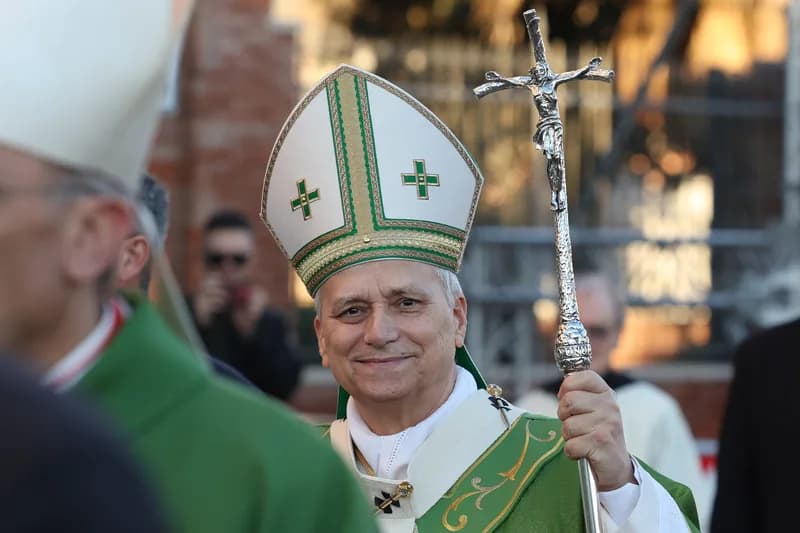
Lebanese Army Intelligence has arrested a Syrian national affiliated with the Islamic State who told investigators that the biggest mission assigned to him by the group was the assassination of Pope Leo XIV during the pontiff's visit to Lebanon in late 2025, according to information obtained by the broadcaster Al Arabiya.
The man was detained in the Batroun area of northern Lebanon after what security authorities described as intensive monitoring and tracking operations, and an unnamed Lebanese security source described the case on September 24, 2026. He has since been handed over to the Military Court for prosecution, the Lebanese broadcaster MTV reported.
During questioning, the detainee admitted that he had remained in constant contact with the group's leadership in Syria, which had given him several tasks in Lebanon aimed at destabilising security and spreading fear among the population. By his own account, the plan to kill the pope was the "biggest mission" he was handed. The Syrian leadership instructed him to carry out the attack, sources familiar with the case said.
Tracked from the border to Batroun
Military Intelligence had followed the man from the moment he entered the country, tracking him until it located and arrested him in Batroun. He had crossed into Lebanon illegally. The account obtained by Al Arabiya described him as maintaining his contacts with the Islamic State and holding a position of responsibility inside the organisation. He was kept under close surveillance in the north before the detention.
The Lebanese Army Command has not issued an official statement confirming the alleged plot or the charges. Every published account of the case rests on unnamed security sources speaking to Lebanese and Saudi outlets.
His mobile phone was emptied of its contents before he was handed to the Military Court, MTV reported. What investigators recovered from it has not been described publicly.
Reports on the case did not say when the arrest took place. The detainee has been identified publicly only as a Syrian national and by an alias.
MTV named the suspect by the alias Al-Daamish and placed him high in the organisation's structure, saying he had served as the group's deputy governor for Aleppo province before his capture. The broadcaster's reporting traces a path up through the ranks of the insurgency in Syria. A post at that level gave him working knowledge of the group's tactics and of how its networks are coordinated.
Three years in a Syrian prison
The Syrian civil war shaped his path to Lebanon. Al-Daamish had earlier been apprehended by the security apparatus of the former Syrian government and spent three years in prison, according to MTV.
The Assad government collapsed in December 2024 and its prisons were thrown open as the state security apparatus came apart. He got out. He exploited the porous border and the security vacuum that followed to enter Lebanon illegally, then went underground, the broadcaster reported.
Once settled in Lebanon, he re-established contact with his former commanders in the Islamic State network, MTV reported. A senior figure in the group gave him direct orders to carry out a high-profile operation, and the objective set for him was the assassination of the head of the Catholic Church during the pastoral visit. The order, on that account, came from outside Lebanon.
Lebanese authorities intend to pass what the detainee told them about his links to the Islamic State to their Syrian counterparts, according to the Al Arabiya account. Security cooperation and coordination between the two countries are already permanently in place.
Accounts differ on how far preparations went
The account obtained by Al Arabiya holds that he never got that far. Sources familiar with the case said the leadership in Syria ordered the attack, but that he was unable to move to the operational stage because he lacked the resources for it. On that telling the limit on him was means rather than intent, and the plot stayed on the planning side of the line.
MTV's account places him further along. Army intelligence investigations found that he had conducted extensive ground surveillance, monitoring the specific routes and venues the pontiff was scheduled to visit, though it also found he was unable to carry out the mission. He moved through areas along the planned route looking for a weak point in the security perimeter that could be exploited for a lethal strike.
What stopped him, in that version, was the deployment itself. Lebanese security forces built a dense security cordon around the papal itinerary, and the strict measures accompanying the visit proved impenetrable. The heavy security presence over the three days was the decisive factor in keeping him from moving from planning to execution, and he delayed his plans and never executed the mission.
The two versions converge at the end. He had begun preparing for the attack but never reached the execution stage, and the pope's visit to Lebanon passed without an attempt on his life.
The pope's schedule in Lebanon
Pope Leo XIV was in Lebanon from November 30 to December 2, 2025, the second and final leg of his first trip abroad as pontiff, which began in Turkey on November 27. The Lebanese Army adopted tight security measures for the three days, which took him across the country rather than holding him in one city. The routes and venues on that itinerary were the ground the suspect is said to have surveyed.
The schedule was packed. It included meetings with Lebanon's top officials and with the country's Catholic patriarchs, visits to monasteries and shrines, a meeting with thousands of young people and a holy mass. The activities were held at different locations across the country, which spread the security effort over multiple sites.
The charges he is expected to face
Accounts differ on where the case now stands. MTV reported that he has been handed to the Military Court. The Al Arabiya account says his file is due to be referred to the judiciary once army intelligence finishes questioning him.
He is expected to face charges of belonging to a terrorist group, planning terrorist operations and attempting to assassinate an international religious figure. Investigators also say he was tasked with carrying out operations aimed at destabilising Lebanon's security. He has not been tried or convicted, and the case rests with the military judiciary.
Northern Lebanon and dormant cells
Northern Lebanon, and Tripoli and the Akkar region above all, has long been a centre of extremist activity, a pattern rooted in economic marginalisation, sectarian tension and the spillover of the Syrian conflict across the border. Those conditions have made parts of the north and northeast the setting for repeated counter-terrorism operations. Batroun, a Christian majority district on the northern coast, sits outside that pattern.
The Lebanese Armed Forces have run numerous raids to dismantle cells tied to the Islamic State and to al-Qaeda, and Lebanese authorities have announced several arrests of senior Islamic State operatives and other members in recent years. The ideology and the network structures behind those cells have proved resilient. Loss of territory has not ended the group's ability to issue orders across a border.
A Lebanese security source said the danger posed by other Islamic State operatives in the country still exists, while describing the situation as under security control. Some people who hold those beliefs, whether from the Islamic State or other groups, form dormant cells, the source said, adding that the authorities remain on alert.
Hosting a papal visit brings its own burden. It requires coordination between the Lebanese state and the Vatican, in a country where the authority of the state is frequently challenged by powerful non-state actors. Protecting a visiting pontiff in that setting leaves little room for error.
The Islamic State has shifted toward high-visibility, symbolic attacks as it has lost territorial control, operations meant to project power and to spread fear. An attack on a global religious leader would have carried heavy propaganda value for the group, could have inspired others to act on their own, and could have destabilised Lebanon's fragile sectarian balance.
Evidence now before the Military Court
Investigators hold the confession the detainee gave under questioning and whatever was recovered from his phone, MTV reported. The prosecution will run through the Military Court. He remains in custody, and Pope Leo XIV's three days in Lebanon ended without an attack.
Sources
- Naharnet: Lebanon arrests IS commander who was tasked with assassinating pope (MTV report, in English)
- Italpress: Syrian ISIS member arrested in Lebanon over alleged plot to assassinate Pope Leo XIV during his 2025 visit (the Al Arabiya account)
- UPI: Syrian IS member arrested in Lebanon over plot to assassinate the pope
- ANHA: Syrian man arrested in Lebanon over alleged plot to target pope during visit
- The New Arab: Lebanon arrests IS operative tasked with assassinating Pope Leo